In the high-stakes world of journalism, we often say that the best stories aren’t found—they find you. In the sweltering summer of 1967, a single shutter click immortalized an act of raw courage and split-second intuition that would save a life and define a professional legacy. The resulting image, famously titled “The Kiss of Life,” stands today as one of the most visceral and iconic entries in the history of photojournalism. It is more than just a picture; it is a document of a heartbeat reclaimed at the edge of the abyss, where one electrical worker risked everything to pull a colleague back from a high-voltage death. More than half a century later, its power remains undiminished—a timeless testament to the extraordinary bravery dormant within ordinary people.
A Routine Assignment Fractures
On that July morning, Rocco Morabito, a veteran photographer for the Jacksonville Journal, was stuck in the doldrums of a slow news day. He was en route to cover a minor, unremarkable event near West 26th Street in Jacksonville, Florida. By his own later admission, he was battling the professional monotony that comes with years on the beat.
That boredom evaporated the moment he crested a hill and saw a frantic scene unfolding around a utility pole. A crowd was gathering, their faces tilted upward in a collective expression of horror. Instinct took over. Morabito slowed his car, grabbed his camera, and stepped into a life-or-death drama that would change the trajectory of his career.

The 4,000-Volt Shock
High above the pavement, the situation was catastrophic. Two linemen had been performing what should have been routine maintenance. One worker, J.D. Champion, reached out and accidentally made direct contact with a high-voltage line carrying an estimated 4,000 volts.
The physics of the accident were brutal. To put it in perspective, the historic electric chairs used for executions typically utilized 2,000 volts; Champion had been hit with double that amount. The current surged through his body, stopping his heart and lungs instantly. He slumped over, unconscious and technically dead, saved from a fatal fall only by his safety harness. He hung there, a limp silhouette against the Florida sky, as the seconds that define survival began to tick away.
Heroism at Altitude
Randall G. Thompson, a fellow lineman working on a lower section of the pole, saw his partner go dark. He didn’t wait for a ground crew or emergency services. Thompson raced up the pole, his movements fueled by adrenaline and years of training.
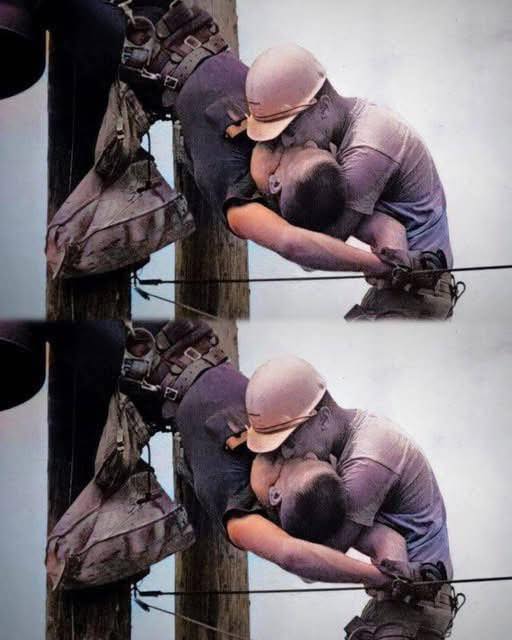
The scene was gripped by a paradoxical atmosphere: a cacophony of panicked onlookers below, and a stark, focused silence on the pole. Thompson reached Champion and immediately confirmed the worst: no pulse, no breath. Suspended precariously in mid-air, without the space to perform traditional chest compressions, Thompson utilized the only tool he had left. He tilted Champion’s head back and began mouth-to-mouth resuscitation right there, hundreds of feet above the asphalt.
Capturing the Decisive Moment
As Thompson breathed life into his friend, Morabito’s professional instincts merged with the gravity of the moment. He recognized that this wasn’t just an accident; it was an epic of human connection. He positioned himself, adjusted for the harsh midday light, and framed the shot.
The resulting photograph captured the pinnacle of the struggle: Thompson’s face pressed against Champion’s, two men bound by a harness and a shared destiny. It was a masterclass in what Henri Cartier-Bresson called “The Decisive Moment.”
As Thompson continued his desperate efforts, Champion’s body finally flickered back to life. By the time ground crews lowered him and paramedics arrived, he had a pulse and was breathing independently. Against all mathematical and medical odds, he had survived.

The Pulitzer and the Legacy
Back at the Jacksonville Journal, Morabito’s editors immediately realized the magnitude of the image. The original minor story he was sent to cover was forgotten. When the photo hit the wires, it surged across the globe. The title, “The Kiss of Life,” became shorthand for the ultimate act of fraternal love and professional duty.
In 1968, the Pulitzer Prize committee awarded Morabito the top honor for Spot News Photography. They cited the image’s raw emotional intensity and its perfect execution under pressure. It remains a staple in journalism schools, not just as a technical example of great lighting and framing, but as a study of the ethical and narrative power of the lens.
The Quiet Aftermath
Remarkably, both men returned to their lives. J.D. Champion made a full recovery and eventually returned to work. Randall Thompson, the man who breathed life back into him, remained famously humble, later telling interviewers, “I just reacted. Anyone in my position would have done the same.”
That humility only deepened the resonance of the story. It was a victory for the “ordinary” man. While Morabito continued a distinguished career at the Journal, he never again captured anything that spoke so clearly to the human soul as that afternoon in 1967.
Why It Still Matters
“The Kiss of Life” continues to circulate today because it strikes four universal chords:
-
Direct Human Connection: It shows the literal bridge of breath between two people.
-
Professional Bravery: It honors the risks faced by those who maintain the infrastructure of our lives.
-
The Immortality of the Lens: It proves that without the journalist, this act of heroism might have vanished into a local archive.
-
Universal Hope: It provides a visceral answer to the question of whether we will help our neighbor in a crisis.
Ultimately, Morabito’s masterpiece reminds us that heroism doesn’t always wear a cape. Sometimes, it wears a hard hat and a safety belt, and it shows up on a Tuesday morning just when the world seems most mundane. It is a story frozen in silver halide—a reminder that life can be reclaimed, one breath at a time.