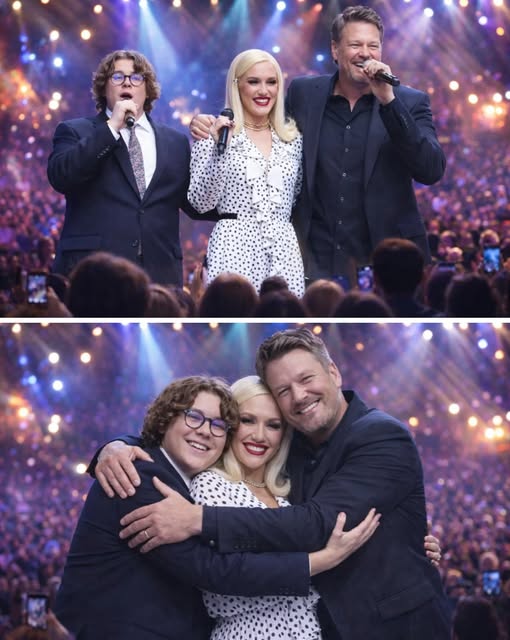
In the frenetic ecosystem of celebrity journalism, where silence is often mistaken for crisis and every missed public appearance is cataloged as evidence of a “split,” the most resonant messages are rarely found in press releases. They are found in the front row of a crowded bar in Tishomingo, Oklahoma.
For weeks, the digital echo chamber had been humming with rumors of tension between music industry titans Blake Shelton and Gwen Stefani. But as the couple stepped into the light recently, they offered no formal rebuttals or defensive interviews. Instead, they stood in quiet unity to watch 16-year-old Zuma Rossdale take the stage—a move that effectively silenced the noise by simply refusing to acknowledge it.
Family Over Friction: The Zuma Debut
Zuma, who has spent much of his life shielded from the invasive glare of his parents’ fame, stepped into the spotlight not as a media stunt, but as a budding artist in his own right. Performing at Shelton’s Ole Red venue, the teenager delivered a poised, country-inflected set that showcased a confidence clearly nurtured far away from the cameras.
For those watching, the story wasn’t just the music. It was the sight of Shelton, the seasoned country veteran, beaming with a pride that required no caption, and Stefani, the global pop icon, watching with a gaze that spoke volumes about familial stability. In that moment, the “power couple” dynamic was eclipsed by something far more relatable: two parents anchored by the shared success of their child.
The Anatomy of a Modern Rumor Mill
Living under the microscope of a high-profile marriage in 2026 means navigating a landscape of “predictable patterns.” As Shelton himself recently noted in an interview with Country Countdown USA, the narrative is often dictated by the mundane:
-
The “Split” Narrative: Triggered when the couple isn’t photographed at a grocery store for a week.
-
The “Reconciliation” Narrative: Triggered the moment they are seen together.
-
The “A.I.” Factor: The rise of manipulated images that make even the principals do a double-take at their own social media feeds.
By choosing presence over pronouncements, Shelton and Stefani are demonstrating a lesson in modern subtlety. They are reminding a gossip-hungry public that a family’s strength is not something to be defended—it is something to be lived.
A Different Kind of Parenting
Raising children in the music industry’s crosshairs is a high-stakes gamble. Zuma’s appearance was a masterclass in how to manage that transition. He appeared:
-
Ready, Not Pushed: His comfort on stage reflected a childhood rooted in genuine encouragement rather than manufactured celebrity.
-
Authentic, Not Performative: Dressed in Western wear and a black cowboy hat, he leaned into his own growing love for ’90s country gold, showing a personal identity separate from his mother’s pop roots.
-
Guided, Not Controlled: Shelton and Stefani’s decision to let Zuma take the lead—selling his own merch and choosing his own setlist—highlights a parenting philosophy that prioritizes autonomy and dignity.
The Power of “No Comment”
In an era of over-explanation, the Shelton-Stefani-Rossdale family offered a quietly revolutionary alternative. They allowed their actions to communicate their truth. The lack of a verbal statement was, in itself, the most powerful statement possible. It suggested that their personal world is intact, resilient, and—most importantly—private.
As Zuma continues to find his voice, he does so from a foundation of evident stability. For the public, the takeaway is clear: while the world may continue to dissect every glance, the strongest bonds don’t need a microphone to be heard. They are visible in the shared smiles, the quiet encouragement, and the simple act of standing together when the music starts.