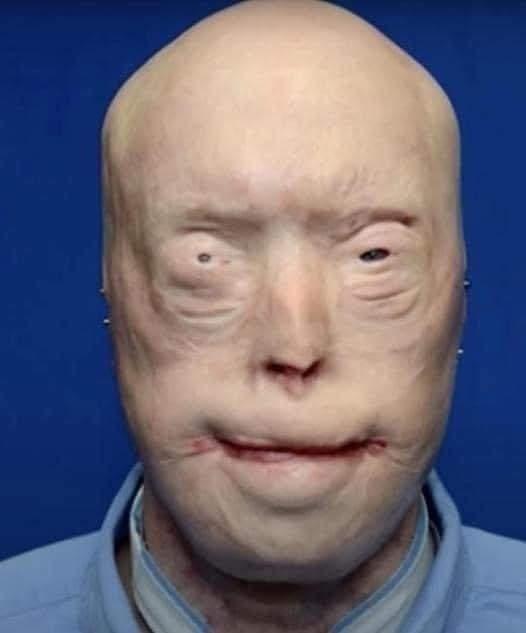
In the annals of medical history, few stories capture the intersection of human tragedy and scientific triumph quite like that of Patrick Hardison. Once a man who lived behind a curtain of sunglasses and baseball caps to shield the world from his scars, the Mississippi volunteer firefighter has become a living testament to the frontier of reconstructive surgery.

The narrative of Hardison’s life is a “before and after” of staggering proportions. Today, he is a man who can blink, eat without pain, and walk through a crowd unnoticed—simple dignities that were stolen from him in a 2001 inferno.

The Fire That Changed Everything
In September 2001, Hardison responded to a routine house fire call that took a catastrophic turn. Believing a woman was trapped inside the structure, he entered the blaze just as the roof collapsed. The intensity of the heat was so great that Hardison’s protective mask began to melt onto his skin. He managed to leap through a window to safety, but the damage was done.
Hardison arrived at the hospital with third-degree burns across his entire face, head, neck, and upper torso. He had lost his ears, his lips, his nose, and almost all his eyelid tissue. The injuries were so severe that his friend and fellow first responder, Jimmy Neal, remarked that he had never seen anyone burned that badly who remained alive.
The psychological toll was as grueling as the physical. For years, Hardison lived a life of isolation. “You go to the ball field, you have to prepare yourself for the kid that goes running off screaming,” he recalled. Even after 71 surgeries, he remained a man without a face, reliant on skin grafts that lacked the musculature required for expression.

The 50/50 Gamble
By 2012, Hardison’s life was at a standstill. His vision was failing because he could not close his eyes to protect them. It was then that a friend discovered the work of Dr. Eduardo D. Rodriguez at NYU Langone Medical Center. Rodriguez was a pioneer in the burgeoning field of facial transplantation, a procedure first successfully performed on France’s Isabelle Dinoire in 2005.
The risks were astronomical. Doctors were candid with Hardison: the procedure carried a 50/50 chance of survival. For Patrick, the choice was clear—a chance at a normal life was worth the risk of losing it.
The search for a donor lasted a year. In 2015, a match was finally found. David Rodebaugh, a 26-year-old BMX enthusiast and artist, had been declared brain-dead following a tragic cycling accident in New York. With the blessing of his mother, Nancy Millar, David’s organs—and his face—were donated to save and transform lives.

A 26-Hour Masterpiece
The surgery was an unprecedented feat of coordination. For 26 grueling hours, more than 100 medical professionals worked in two synchronized teams. They had to meticulously connect nerves, blood vessels, and bone to ensure the transplant would not only “take” but also function.
The success of the operation was immediate and historic. It was the most extensive face transplant ever performed, providing Hardison with new ears, a nose, lips, and, crucially, functional eyelids.
Today, Hardison’s recovery has defied expectations. He is no longer a spectacle of curiosity but a father who can attend his children’s sporting events as just another face in the crowd. His journey from the ashes of a Mississippi fire to the surgical theaters of New York serves as a powerful reminder of the “superhero” status of modern medical professionals and the enduring resilience of the human spirit.
“I said, ‘You better save his face. He has the face of a porcelain doll.’”
Those were the words of Nancy Millar as she faced the unimaginable: the death of her son, David Rodebaugh. But even in the depths of her grief, Millar remembered a conversation she and David had once shared. He was a donor. When she heard about Patrick Hardison—a man whose face had been erased by fire—she didn’t hesitate. For her, the transplant was not just a medical procedure; it was a way for David to live on.
“When I met Patrick, I saw this strength, this strong, manly, burly kind of energy in him—that David had,” Millar recalled. To her, the connection was spiritual. David had dreamed of being a firefighter, and Patrick was a man who had actually walked into the flames to save others. In Millar’s eyes, Patrick possessed the same soul-deep resilience that defined her son.

A 26-Hour Descent into the Unknown
With a donor match secured, Dr. Eduardo D. Rodriguez mobilized a small army of 100 doctors, nurses, and specialists at NYU Langone Medical Center. The task ahead was monumental: the most extensive soft-tissue face transplant in history.
For 26 grueling hours, the team worked with microscopic precision. They didn’t just move skin; they transplanted a new scalp, ears, and ear canals. They harvested and integrated portions of the chin, cheeks, and the entire nasal structure. Most significantly, Patrick received new eyelids, a feat of surgical engineering that restored his biological ability to blink.
The stakes could not have been higher. Because of the sheer complexity of the vascular and neurological connections, Patrick was given a 50/50 chance of surviving the operating table.
“Everything in life has a risk,” Hardison told Time Magazine with the stoicism of a first responder. “When it’s your time to go, you’ll go—whether you’re walking down the street and get hit by a car or you’re lying on the operating table.”

The Promise to a Daughter
Before the anesthesia took hold, Patrick met with his family for a farewell that many feared was final. His eldest daughter, Alison, struggled to understand why her father would gamble his life on such a dangerous operation.
His answer was simple, focused not on vanity, but on the milestones of fatherhood. “He said, ‘I won’t have to wear a ball cap and I won’t have to wear my sunglasses. I’ll look normal whenever I get to walk you down the aisle,’” Alison recalled. “And that right then pretty much sealed the deal for me.”
The surgery was a success, but the victory was followed by a harrowing recovery. The first week was a gauntlet of fluctuating blood pressure and airway instability. The new face was a stranger to his body; Patrick had to learn to speak and swallow again. The swelling was so intense he could not close his mouth, leading to bouts of profound anxiety and frustration.

A New Identity, Seven Years Later
Seven years have passed since that historic day in 2015. While the physical transformation is complete, the personal journey has seen its share of upheaval. Patrick and his wife, Chrissi, divorced a year after the surgery following a ten-year marriage. Yet, the biological miracle holds firm. While Patrick must remain on a lifelong regimen of anti-rejection drugs to prevent his immune system from attacking the transplant, the swelling has vanished, leaving a face that has healed into a new, permanent identity.
The emotional arc of the story reached its zenith when Patrick finally met Nancy Millar. The woman who gave him her son’s face had only one request: “Can I kiss your forehead?”
“That’s the one thing I wanted to do because every night before David went to bed when he was little, I kissed his forehead,” Millar said.
Patrick, deeply moved, described the bond as instantaneous. “I’ve been waiting a year to meet her. Without her, it wouldn’t have been possible. It’s like she’s family.”
The Message of the Survivor
Today, the father-of-five is no longer hiding. He has reclaimed his independence, purchasing his own property and working on a book to document his journey. He views his new face not as a trophy of medical science, but as a platform for advocacy.
“I want to show the world that you can have hope,” Hardison told Fox in 2021. “I wouldn’t want people that were like me years ago to think that’s it, I have to live like this. You don’t. You can accomplish anything.”
Hardison’s story remains a testament to the heroism of donors like David Rodebaugh and the visionary skill of Dr. Rodriguez’s team. They provided more than a surgical success; they restored a man’s ability to look the world in the eye.