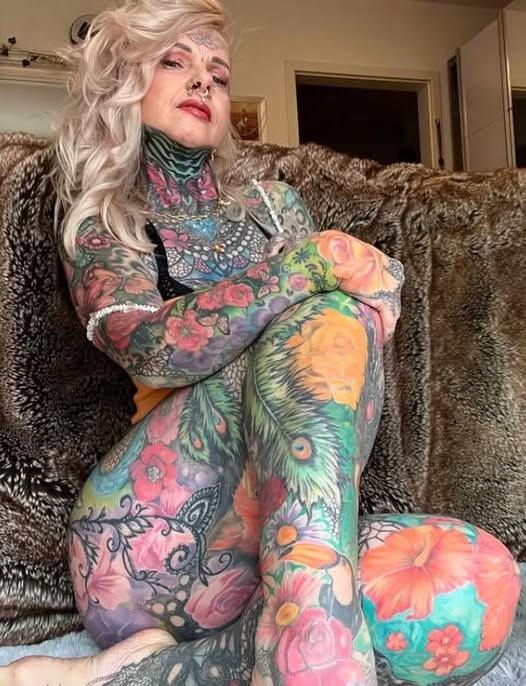
Grandma reveals what she looked like before full body tattoos!
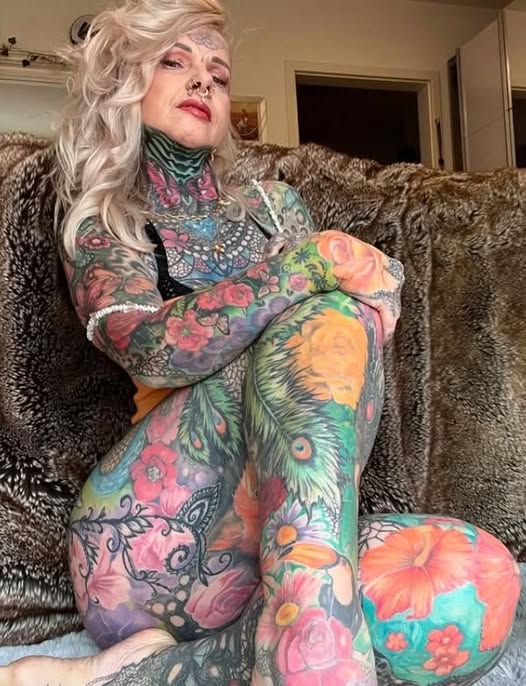
For decades, Kerstin Tristan believed she knew exactly where she stood on tattoos. She disliked them, dismissed them, and never imagined that body art would play any role in her life. Today, at 56 years old, she is a mother, a grandmother, a social media personality, and one of the most recognizable examples of how radical self-expression can rewrite expectations around age, beauty, and identity. Her body is now fully covered in tattoos, a transformation so striking that photos of her before and after continue to captivate audiences around the world.
Kerstin’s story did not begin with rebellion or a lifelong fascination with ink. It began with restlessness. By her early fifties, she had lived what many would consider a complete, responsible life. She raised a family, followed social norms, and played the roles expected of her. But somewhere along the way, she felt an unmistakable urge for change. Not a cosmetic tweak or a passing hobby, but something deeply personal—something that felt real.
In 2015, that feeling crystallized into a single decision. She booked her first tattoo.
“I simply wanted to try something new,” she later explained. “We only live once, and I felt that at my age, something real had to come.” That one experience shattered her long-held assumptions. What she expected to be uncomfortable or regrettable became empowering. The process, the permanence, and the artistry all resonated with her in a way she hadn’t anticipated.
That first tattoo opened a door she never closed again.
Over the next several years, Kerstin committed herself fully to body modification art. She didn’t approach it casually. Each piece was intentional, layered, and part of a broader vision. Roses bloomed across her legs in vivid color. Leopard patterns spread across her shoulders. Highly detailed portraits, floral designs, and symbolic elements filled her arms, torso, and neck. Eventually, there was no untouched canvas left.
The financial commitment alone reflects how serious she was about the transformation. Since 2015, Kerstin has spent approximately €30,000—more than $32,000—on tattoos. For some, that number might seem shocking. For her, it was an investment in identity, confidence, and freedom. She didn’t see the money as lost. She saw it as claimed.
What truly surprised her was the response from the outside world.
In an age driven by digital platforms and visual storytelling, Kerstin’s transformation found an audience quickly. Her Instagram account grew to more than 190,000 followers, while her TikTok videos accumulated millions of views. People weren’t just curious—they were inspired. Many were stunned by the contrast between her earlier, tattoo-free appearance and the bold, fully inked woman she had become.
She frequently shares comparison photos, showing herself just a decade ago alongside her present-day look. The difference is dramatic, but not just visually. The confidence in her posture, the ease in her expression, and the pride in her presence tell a deeper story. This is not about chasing youth. It’s about claiming authenticity.
“When I look at myself in the mirror,” Kerstin has said, “I see a beautiful meadow full of flowers that one has to love.” That metaphor captures how she views her body now—not as something to hide or explain, but as living art.
Her followers echo that sentiment. Comments under her photos often describe her as a “work of art” or praise her courage for defying conventional standards of beauty. Others thank her for showing that self-expression doesn’t expire with age. In a culture that often marginalizes older women or confines them to narrow roles, Kerstin’s visibility challenges deeply ingrained stereotypes.
What makes her story resonate so strongly is not just the tattoos themselves, but the timing. Society still tends to frame reinvention as something reserved for the young. Midlife and beyond are often portrayed as periods of decline, caution, or invisibility—especially for women. Kerstin’s journey stands in direct opposition to that narrative.
She didn’t get tattoos to shock anyone. She didn’t do it for attention, fame, or rebellion. She did it because something inside her demanded expression. That distinction matters. It reframes body art not as defiance, but as alignment.
From a broader cultural perspective, her story intersects with growing conversations around age inclusivity, body positivity, and personal branding. In the world of influencer marketing, wellness culture, and digital self-expression, authenticity has become a premium value. Kerstin embodies that shift. She is not trying to look younger. She is not chasing trends. She is unapologetically herself.
There is also an economic angle to her transformation that often goes unspoken. The tattoo industry, once niche and stigmatized, is now a multi-billion-dollar global market. High-end tattoo artists, custom designs, and long-term body modification have become part of luxury self-expression. Kerstin’s commitment places her firmly within that modern reality, where art, identity, and investment intersect.
Criticism still exists, of course. There are those who question her choices, who argue that tattoos at her age are inappropriate or excessive. But those voices are increasingly drowned out by a louder, more supportive chorus—people who see her as proof that fulfillment doesn’t have an expiration date.
Kerstin Tristan did not lose herself in ink. She found herself there.
Her journey sends a clear message: expression is not reserved for the young, the trendy, or the approved. It belongs to anyone willing to listen to their inner voice and act on it. Whether through tattoos or any other form of self-definition, the courage to evolve remains one of the most powerful human traits.
In a world obsessed with conformity and timelines, Kerstin chose transformation on her own terms. And by doing so, she became more than a grandmother with tattoos. She became a symbol of late-blooming freedom, embodied confidence, and the enduring right to live authentically—at any age.