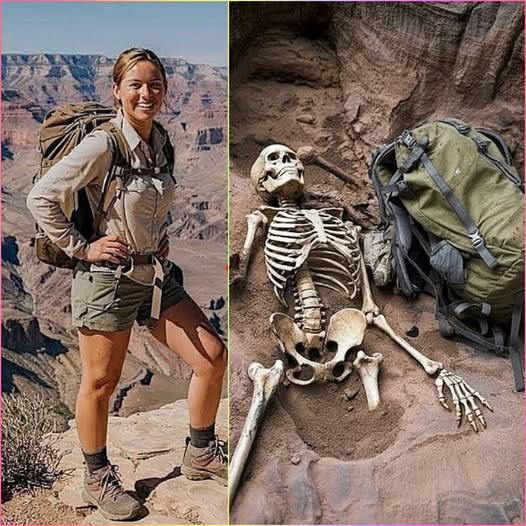
The Grand Canyon is a cathedral of stone and silence, a jagged scar carved into the earth by the relentless passage of eons. To the casual observer on the rim, it is a masterpiece of shifting colors and pooling shadows; to those who descend into its depths, it is a labyrinth where the line between wonder and peril is as thin as a canyon breeze. Most who enter return with their stories intact, but in May 2014, the canyon claimed a narrative it refused to relinquish. Dana Blake, a twenty-nine-year-old wilderness photographer, walked into the vastness of the Tanner Trail and simply vanished. There were no distress signals, no frantic calls for help—only a profound, hollow silence that would last for a decade.
Dana was not a novice. She was a woman who moved through life with a fierce, restless independence, a professional who hunted photographs as if they were secrets the world was trying to hide. Her sister, Rachel, remembered her as a meticulous planner who carried satellite gear, understood water caches, and respected the desert’s lethality. On the morning of May 20, 2014, a ranger camera captured the last known image of Dana: she was adjusting her pack at the trailhead, caught mid-smile in the soft morning light, looking exactly like someone who was where she wanted to be. She logged her intent to camp at the river for two nights and disappeared into the heat.
When three days passed without a check-in, the routine welfare check spiraled into one of the most baffling missing-person cases in the park’s history. Searchers located her campsite near the Colorado River, tucked neatly beneath a cottonwood tree. The scene was chilling in its normalcy. Her tent was pitched correctly, her sleeping pad was rolled, and a pot of partially cooked quinoa sat cold by an unused fire ring. Her boots were lined up side-by-side outside the tent, and her trekking poles leaned against a nearby rock. It appeared as though she had simply stepped out for a moment and never returned. However, two things were missing: her Nikon camera and the SD card from her spare pack. Most hauntingly, a hand-drawn map pinned inside the tent showed a single, handwritten line curving away from her planned route into an unmarked side canyon with a cryptic note: “Shortcut? Check tomorrow.”
For nine days, helicopters, drones, and K-9 units combed a hundred square miles of vertical wilderness. Searchers shouted her name into an expanse that offered no echoes. There were no footprints leading away from the site, no blood, and no signs of a struggle. It was as if the rock had simply absorbed her. When the official search was called off, the public moved on, but Rachel Blake did not. She quit her job, bought a rugged 4Runner, and dedicated her life to the canyon. Every year on the anniversary of the disappearance, Rachel returned to “Blake’s Bend,” an unnamed drainage corridor she had mapped out herself, following the intuition that Dana hadn’t gotten lost—she had found something.
The mystery deepened in 2017 when reports began surfacing of a “Ghost of the Tanner Trail.” Multiple experienced backpackers reported seeing a solitary woman in a sun-bleached hat and a green pack standing on inaccessible ledges near Phantom Ranch. She never spoke or waved; she simply watched, then stepped behind a boulder and vanished into terrain where no trail existed. Rachel eventually obtained a grainy, distant photo from a hiker. When she zoomed in, her breath hitched. The figure was wearing a pack with a hand-stitched crescent moon—the exact patch Rachel and Dana had sewn together when they were children.
The “chilling discovery” that finally broke the decade of silence came in August 2024. A rare, violent monsoon had roared through the Escalante drainage, scouring dry washes and unearthing secrets buried in the limestone. Two geology students mapping erosion patterns found a warped, water-damaged notebook wedged in a crevice. It was Dana’s signature green journal. While the pages were bloated and stained, her angular, confident handwriting remained legible. The early entries were typical field notes—observations on light angles and river levels—but toward the end, the tone shifted into a register of primal fear. She wrote of hearing sounds that were neither wind nor animal. The final line, scrawled across a page smeared with red dust, read: “It’s watching me.”
This discovery prompted a veteran search-and-rescue ranger, Mark Delaney, to cross-reference Dana’s case with cold files from previous decades. He uncovered a terrifying pattern. Dana was not the first. In 2009, a botanist named Elena Voss had disappeared from a neat campsite with an open journal. In 2012, a photographer named Stephanie Reed had vanished, leaving only her boots beside a wash. All three women were solo hikers, all were highly prepared, and all had disappeared within a specific radius of an unmarked corridor locals called “Raven’s Hollow.”
This realization changed the narrative from a series of tragic accidents to something far more sinister. The canyon was no longer just a backdrop for a disappearance; it was a witness to a predator—or a phenomenon—that targeted the solitary and the brave. The discovery of the journal proved that Dana had survived much longer than the initial search teams had assumed. She had climbed into the high crevices to escape something, writing her final words while trapped in the stone.
The legacy of Dana Blake now lives on in the “passive” files of the National Park Service and the active obsession of her sister. Rachel continues to hike the Tanner Trail, no longer looking for a living sister, but for the “erosion light” Dana had died trying to capture. The story serves as a somber reminder that in the Grand Canyon, safety is often an illusion. You can prepare for the heat, the thirst, and the terrain, but you cannot prepare for the secrets that wait in the shadows of Raven’s Hollow. The canyon remembers Dana Blake, and in the quiet of the dawn, those who listen closely claim they can still hear the scratch of a pen against paper, recording the beauty of a place that never lets its visitors go.