In 1966, Batman wasn’t merely a cinematic release; it was a pop-culture detonation that fundamentally recalibrated the trajectory of superhero media. Starring Adam West and Burt Ward, the film became the definitive embodiment of 1960s camp—a vibrant, over-the-top spectacle that mirrored a decade defined by pop art, psychedelic aesthetics, and a subversive sense of irony.
Yet, as is often the case with legendary productions, the stories unfolding behind the camera—ranging from cynical studio maneuvering to unexpected wardrobe malfunctions—are just as compelling as the “Biff!” and “Pow!” antics immortalized on screen.

The Cynical Genesis of a Classic
To look back at the first Batman feature is to see a brilliant time capsule of mid-sixties America. The eye-popping palette and absurdly exaggerated combat were more than just stylistic choices; they provided a necessary escapism. In 1966, the United States was a nation in the throes of transition, grappling with political upheaval and social revolution. For audiences of the era, there was no better sanctuary than a world where the most dire threat could be neutralized with a laugh track.
However, the film’s origin story is rooted in cold, hard Hollywood pragmatism. Producer William Dozier initially envisioned the movie as a high-octane marketing tool, hoping to release it before the television series debuted to generate massive hype.
It was a strategic masterstroke that hit a wall at 20th Century-Fox. The studio, ever cautious, refused to shoulder the financial burden of a feature film when they could mitigate their risk by sharing the costs of a television series instead. In a classic Hollywood power play, Dozier was left to navigate the movie route largely on his own while the studio played it safe—a calculated gamble that would eventually pay dividends in cultural immortality.
Adam West’s High-Stakes Ultimatum
By the time the film reached theaters, Adam West was a bona fide sensation. With his chiseled features and commanding baritone, he was the quintessential all-American Bruce Wayne. But West’s path to the cowl was an intentional transformation; born William West Anderson, he rebranded himself “Adam West” upon arriving in Hollywood in 1959.
Dozier didn’t discover his Batman in a prestigious drama, but rather in a Nestlé Quik commercial, where West played a James Bond-esque spy named Captain Q. When West finally laid eyes on the pilot script, he was captivated within twenty pages, recognizing the specific brand of comedy he had been searching for.
The role eventually came down to a screen-test showdown between West and Lyle Waggoner. West ultimately agreed to sign on, but only after securing two non-negotiable conditions: he demanded more screen time as Bruce Wayne to showcase the man behind the mask, and he insisted on approval over his co-star. It was West who gave the green light to Burt Ward, a brown belt in karate who possessed zero professional acting experience but perfect chemistry with his lead.
West’s approach to the character remained nuanced, even amidst the camp. As he noted in 2006: “You can’t play Batman in a serious, square-jawed, straight-ahead way without giving the audience the sense that there’s something behind that mask waiting to get out—that he’s a little crazed, he’s strange.”
The Double-Edged Sword of the Cowl
Despite the global adoration, the role of Batman became a “curse in disguise” for West. Though his filmography was extensive, he found himself perpetually typecast as “TV’s Batman,” a label that made securing dramatic roles increasingly difficult after the caped crusader hung up his utility belt.
West eventually embraced his legacy, making a triumphant late-career comeback as the eccentric voice of the Mayor on Family Guy. He passed away in 2017 following a brief battle with leukemia, leaving behind a legacy that defined a generation of heroism.
The Joker’s Grooming Rebellion
One of the most enduring pieces of trivia from the 1966 production involves Cesar Romero’s refusal to sacrifice his vanity for the sake of the Clown Prince of Crime. Romero, a suave leading man of the era, flatly refused to shave his trademark mustache for the role.
The solution was as campy as the show itself: makeup artists simply slathered the facial hair in thick white greasepaint. While the “cover-up” fooled absolutely no one, Romero’s stubbornness became an unintended part of the character’s charm. Romero passed away in 1994 at age 86, leaving behind two stars on the Hollywood Walk of Fame—one for his contributions to film and another for television.

Lee Meriwether: The “Missing” Catwoman
History often conflates the various actresses who portrayed Catwoman, but Lee Meriwether holds a unique distinction. While Julie Newmar and Eartha Kitt owned the role on the small screen, it was Meriwether—a former Miss America—who donned the claws for the 1966 feature film.
Production on the movie actually commenced before Meriwether was officially cast, leading to a notable continuity error: Catwoman is conspicuously absent from the opening scene aboard the Penguin’s submarine. To prepare for the role, Meriwether famously studied her two pet cats at home. “I watched them carefully,” she told reporters in 1966. “I tried to move as they did—sort of slinky, quiet, yet able to pounce viciously without warning.”

The Rooftop Wardrobe Malfunction
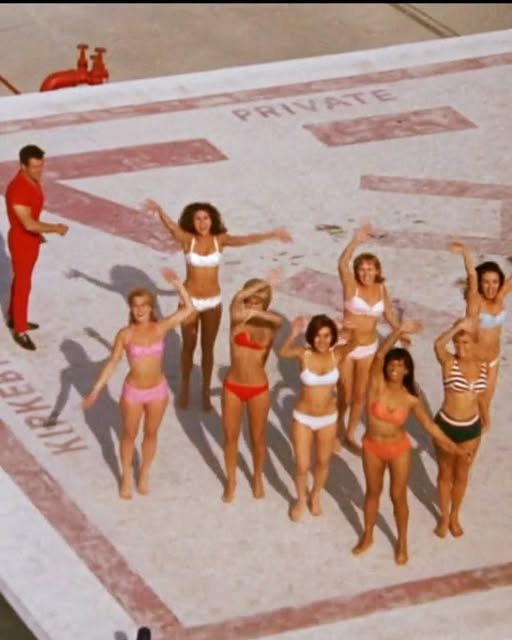
Perhaps the most “blink-and-you’ll-miss-it” moment in the film involves a legendary wardrobe malfunction. Early in the movie, as Batman and Robin soar over “Gotham City” (actually filmed over Los Angeles) in the Batcopter, they pass a group of women in bikinis on a rooftop.
Eagle-eyed viewers and film historians have noted that one of the women, clad in a red bikini, suffered a malfunction as the helicopter passed, revealing a bit more than the 1966 censors—or the actresses—likely intended. It remains a footnote in the annals of superhero cinema, a tiny moment of unscripted reality in a world built on comic book fantasy.
In the world of 1960s television and film, the line between cinematic polish and “making it work” was often as thin as a spandex cowl. As we continue our deep dive into the 1966 Batman feature film, it becomes clear that the production’s enduring legacy is built as much on its imperfections and cheeky historical nods as it is on its neon-lit heroism.
The Mystery of the Rooftop Blur
Returning to that infamous rooftop scene—where the Batcopter passes a group of bikini-clad women—modern viewers have found a digital footprint of a 1960s problem. Because the budget and schedule did not allow for a reshoot of the aerial sequence, the film’s producers were forced to take a pragmatic approach to a wardrobe malfunction: they simply blurred the footage in the final cut.
This editorial “fix” has become a point of fascination on platforms like Reddit, where fans dissect every frame of the Caped Crusader’s history. One user noted the visual confusion caused by the mid-century censorship: “The blur makes it look like she has long hair down her front, but it doesn’t make sense since they are jumping up and down and it looks like she has it in a ponytail. I used to watch this movie all the time and never noticed it.” It remains one of those quirky artifacts that highlights the charmingly haphazard nature of 1960s post-production.

Adam West vs. The Exploding Shark
Perhaps the most enduring bit of trivia from the 1966 movie involves a scene that has become the universal shorthand for “camp”: the Shark Repellent Bat Spray. In interviews conducted years after the film’s release, Adam West revealed that even he struggled to maintain his trademark “bright knight” composure during the sequence.
In the scene, Batman dangles from a helicopter while a clearly rubberized shark latches onto his leg. To the modern eye—and to West’s at the time—the shark looked remarkably, almost proudly, fake. West recalled that the producers were particularly dissatisfied with the foley work and sound effects used when Batman struck the predator. West reportedly chuckled at their concern, telling them it hardly mattered given that the shark itself was so obviously a prop.
The scene is also home to a classic continuity “non-sequitur.” As Batman dangles, Robin is shown hanging upside down directly above him to hand over the Shark Repellent Bat Spray. However, a mere second later, as Batman applies the aerosol to the beast, the Boy Wonder has mysteriously vanished from the frame entirely. Today, this absurdity is viewed not as a failure of filmmaking, but as the core of the film’s charm. Batman wasn’t a gritty procedural; it was a playful satire designed to offer a technicolor reprieve from the heavy sociopolitical climate of the mid-sixties.
A Villainous History Lesson
Beyond the gadgets and the “BAM!” graphics, the 1966 film was surprisingly literate, frequently slipping historical Easter eggs into its campy dialogue. Approximately 15 minutes into the film, The Penguin delivers a line that sounds like a standard villainous ultimatum: “We shall hang together, or most assuredly we shall all hang separately.”
While it fits the Penguin’s theatrical persona, the line is actually a direct quote from Benjamin Franklin during the American Revolution. Franklin allegedly uttered the phrase to his fellow delegates as a warning of the high treason charges they faced from the British Crown. It is a sophisticated nod to history, showing that even Gotham’s most colorful criminals weren’t above a little Revolutionary War rhetoric.

Geopolitics at the United World
The film’s satirical reach even extended to the Cold War. At the one-hour-and-forty-minute mark, a delegate at the “United World” meeting begins banging his shoe on the table in a fit of rage. This wasn’t a random comedic choice; it was a direct parody of Soviet leader Nikita Khrushchev’s infamous shoe-banging incident during the 1960 United Nations General Assembly.
By weaving together wardrobe mishaps, rubber sharks, and Cold War parodies, the 1966 Batman movie secured its place as an unforgettable piece of cinematic history. It remains a vibrant time capsule of an era when superheroes didn’t need to be “dark” to be meaningful—they just needed a good gadget and a sense of humor.