On a humid July night that began with the characteristic stillness of the Gulf Coast, a sequence of split-second decisions transformed a routine evening into a harrowing tableau of life and death. What unfolded at a darkened boat launch on the Pascagoula River was a crisis defined by mechanical error and environmental peril, but it was ultimately resolved by a display of raw, selfless courage that has left seasoned first responders and local officials in awe.
The setting was the Pascagoula River, a broad and deceptively powerful waterway that serves as a vital artery for the region’s maritime identity. At approximately 2:30 a.m., the silence of the waterfront was shattered when a vehicle carrying three teenage girls plunged off a boat ramp and into the deep, moving current.
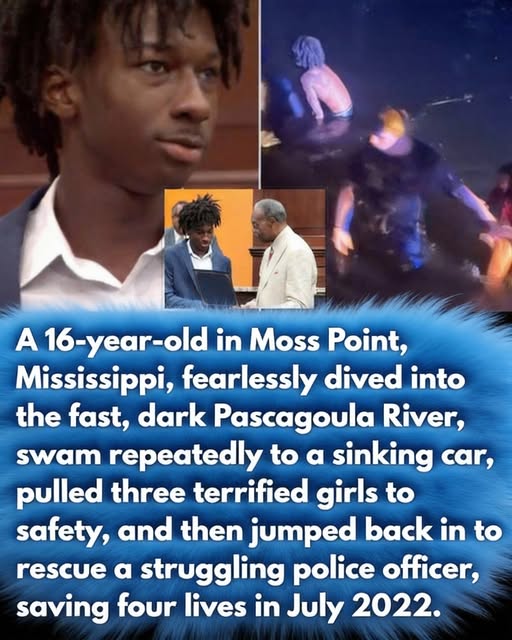
In the desperate minutes that followed, 16-year-old Corion Evans—a rising senior at Pascagoula High School—emerged as the thin line between a tragic headline and a miraculous rescue. His actions, characterized by a staggering lack of hesitation, resulted in the saving of four lives, including that of a police officer who found himself overwhelmed by the very river he had entered to assist.
The GPS Error: When the Road Dissolves into Water
The incident began as a navigational nightmare. According to investigators, the vehicle carrying the three teenagers was traveling toward the I-10 boat ramp in Moss Point—a location where the asphalt terminates abruptly at the water’s edge.
The driver later informed authorities that she had been strictly following her GPS coordinates. In the profound darkness of the unlit ramp, the digital interface failed to distinguish between a continuing roadway and the murky expanse of the Pascagoula. By the time the mistake was realized, the car had barreled off the ramp and into the river.
The vehicle initially floated approximately 20 feet from the shoreline before the weight of the engine block began to pull it into the depths. The three girls managed to scramble through windows and onto the roof, screaming for help as the car drifted further into the center of the river, caught in a current notorious for its strength and ability to sap the stamina of even the most conditioned swimmers.
The Instinct of a Hero: Corion Evans’ Immediate Response
Corion Evans was standing nearby with friends when the screams reached the shore. While many would have been paralyzed by the confusion of the moment, Evans’ reaction was visceral and immediate.
“I just can’t let them die,” Evans later told local news outlets, reflecting on the moment he saw the vehicle’s lights fading beneath the surface. He performed a hurried, tactical shedding of his gear—kicking off his shoes, dropping his shirt and phone on the bank—and launched himself into the water.
Evans was uniquely suited for the task. Having been a swimmer since the age of three, he possessed a level of “aquatic literacy” and comfort in moving water that is rare among his peers. Even so, the Pascagoula is a formidable adversary. Beneath the moonlight, the river’s surface concealed the powerful undertow and the disorienting chill of the deep. Every yard Evans gained was a battle against a current determined to pull him downstream, yet he persisted, driven by an urgent, singular focus on the victims.
The Rescue: A Multi-Stage Battle Against the Current
Upon reaching the sinking vehicle, Evans found the three girls clinging to the roof in a state of sheer panic. The rescue was not a simple matter of towing them back; it required a calculated series of maneuvers to ensure no one was pulled under in the process.
Reports indicate that Evans was not entirely alone in the water. A friend, identified in local accounts as one of the Bradley brothers, also entered the river to provide support. Working in a coordinated effort, they began the grueling process of ferrying the girls to shore one by one.
The physical exertion was immense. Evans had to maintain his own buoyancy while resisting the current and physically propelling a panicked individual toward safety. One of the passengers later recounted the terrifying proximity of her own demise, stating that Evans reached her “right before my last breath.” It was a race against total exhaustion, and Evans was running it on behalf of three strangers.
The Crisis Within the Crisis: Saving the Rescuer
Just as the teenagers were being moved toward the safety of the riverbank, the situation took an even more perilous turn. Officer Garry Mercer of the Moss Point Police Department arrived on the scene and immediately entered the water to assist.
In the chaotic environment of the moving river, a panicked victim began to struggle against the officer’s hold. The sudden shift in weight and movement caused Officer Mercer to lose his footing in the silt and swallow water. Suddenly, the professional rescuer was himself in need of rescue, as the current began to overwhelm him.
Hearing the officer’s struggle, Evans did not pause to recover his own breath. Despite having already made multiple high-intensity trips across the river, he turned back into the deep water. He reached Officer Mercer and used the same determined stroke to bring him to a point where his feet could finally touch the riverbed. By the time all four victims were on land, Evans had performed a feat of endurance that would have challenged a trained lifeguard.
A Community’s Gratitude and the Aftermath
The four individuals—the three teenage girls and Officer Mercer—were transported to a local hospital for treatment related to water inhalation and physical exhaustion. All have since made full recoveries, a fact that Police Chief Brandon Ashley attributed directly to Evans’ intervention. “If Corion had not assisted, it could have possibly turned out tragically,” the Chief noted in a formal statement.
In the days following the rescue, the city of Pascagoula and the Moss Point Board of Aldermen held a public ceremony to honor the young man. Mayor Billy Knight presented Evans with a Certificate of Commendation, marking him not just as a brave teenager, but as a local hero.
Analyzing the Act: The Pillars of Extraordinary Courage
Beyond the drama of the night, the story of Corion Evans offers four critical takeaways for the broader community:
-
The Value of Situational Awareness: Evans’ ability to recognize a life-threatening crisis in its earliest stages was the primary factor in its successful resolution.
-
The Essential Nature of Water Safety: His lifelong swimming experience provided the “toolset” necessary to back up his bravery. Without his technical ability, his intent could have led to a double tragedy.
-
Collaborative Resilience: The presence of his friend and the eventual arrival of Officer Mercer highlight that even the most heroic individual acts are bolstered by a network of support.
-
The Definition of Valor: Courage is frequently misunderstood as a lack of fear. In reality, Evans felt the weight of the danger; he simply chose to prioritize the lives of others over his own safety.
A Lasting Legacy
Years later, the “Midnight Rescue on the Pascagoula” remains a touchstone for the region. Corion Evans’ story is a powerful rebuttal to the idea that heroism is reserved for those with titles or decades of experience. It serves as an enduring reminder that when the road ends and the water begins, the willingness to dive in—despite the risk, despite the fear—is what defines the best of the human spirit.
In a world often defined by its risks, Corion Evans stands as a symbol of hope—a young man who saw a nightmare unfolding and chose to swim toward it.