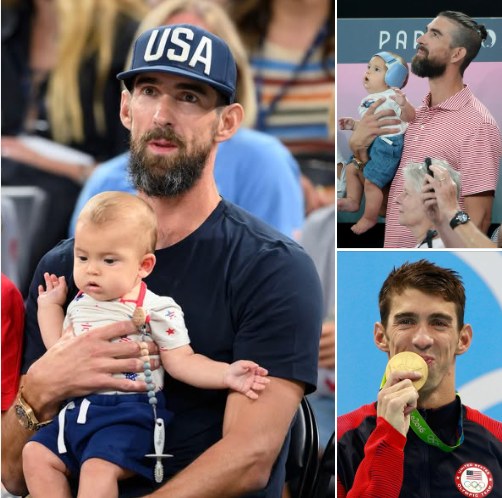
Michael Phelps is no longer just a name etched into the record books; he is the definitive standard by which Olympic greatness is measured. To the casual observer, he is the “Baltimore Bullet,” a human torpedo who redefined the limits of aquatic speed. But to those who have followed his ten-year evolution since his final plunge in Rio, Phelps has become something far more significant: a pioneer of the human spirit. His career statistics are staggering—an unprecedented 28 Olympic medals, including a record 23 golds. To put that in perspective, if Michael Phelps were a country, he would rank above dozens of nations in all-time gold medal counts. Yet, as we move through 2026, it is the story of the man behind the goggles—the struggles with ADHD, the battle with depression, and the transition to a father of four—that resonates most deeply with a global audience.

The Genesis of a Giant: From Baltimore to Beijing
Born June 30, 1985, Phelps’s relationship with the water began as a paradox. The child who would one day become the most decorated swimmer in history originally feared getting his face wet. Diagnosed with ADHD, Phelps found that the pool was the only place where his racing mind could find a singular focus.
Under the tutelage of coach Bob Bowman, that energy was harnessed into a relentless work ethic. Phelps didn’t just participate in the Olympics; he dominated them across five separate Games, from Athens 2004 to Rio 2016. His physical architecture—a 6’7″ wingspan, hyper-mobile ankles, and a lung capacity nearly double that of the average male—made him a biological marvel.
The apex of this dominance arrived at the 2008 Beijing Olympics, where Phelps achieved the “unthinkable”: eight gold medals in a single Games, eclipsing Mark Spitz’s long-standing record and cementing his status as the greatest to ever touch a touchpad.
The Weight of Gold: A Human Story
However, the most compelling chapter of the Phelps narrative isn’t found on a podium. It began in the dark aftermath of the 2012 London Games. Despite his success, Phelps found himself in a harrowing spiral of despair and isolation, a period he now speaks about with unflinching honesty.
“My depression and my anxiety aren’t going to just disappear,” Phelps remarked in a candid interview. By breaking the “tough athlete” archetype, he catalyzed a global conversation on mental health that was once considered taboo in elite sports. He transformed his vulnerability into a mission, using the Michael Phelps Foundation to advocate for water safety and mental wellness. Today, his work as a board member for platforms like Talkspace is arguably as impactful as any world record he set.

The Anchor: Marriage and a Growing Family
As Phelps navigated the transition from “the greatest swimmer” to “a person,” he found his steadfast anchor in Nicole Johnson. A former Miss California USA (2010), Johnson has been the “glue” for the Phelps family through the peaks of Olympic glory and the valleys of retirement.
The couple, who wed in a private Paradise Valley ceremony on June 13, 2016, have since built a life that is a far cry from the grueling 10,000-calorie-a-day training regimens of the past. As of early 2026, the Phelps household is a bustling “house of boys.” Michael and Nicole are now parents to four sons: Boomer (9), Beckett (7), Maverick (6), and their youngest, Nico, born in January 2024.
For Phelps, fatherhood has provided the purpose that gold medals never quite could. He remains active in the sport as a mentor and analyst—most recently seen lending his expertise during the Paris 2024 broadcasts—but his primary focus is now the “queen of the household,” Nicole, and their four boys.
From a restless child in Baltimore to a global icon of resilience, Michael Phelps’s journey reminds us that the hardest race isn’t the one in the pool—it’s the one we run within ourselves. And by any measure, he is still winning.
For years, the world knew Michael Phelps as a relentless machine of aquatic precision, a figure defined by the chlorine of the pool and the weight of 28 Olympic medals. However, a decade after his final plunge in Rio, the narrative of the most decorated Olympian in history has undergone a profound transformation. Today, the man who once measured his life in milliseconds now measures it in the milestones of his four sons and the steady, quiet work of mental health advocacy.
Phelps’s transition into this new chapter began with a wedding that intentionally avoided the glare of the paparazzi. Though the 2016 ceremony was private, its significance was monumental; it marked the formal start of a life increasingly rooted in domesticity and shared experience with his wife, Nicole.
A House of Boys: Raising the Next Generation
Life in the Phelps household is defined by a bustling, high-energy environment centered on four sons: Boomer, Beckett, Maverick, and Nico.
The journey into fatherhood began under the global spotlight. Boomer Robert was born on May 5, 2016, just months before Phelps’s final Olympic run. The image of the infant in the stands in Rio, witnessing his father extend an unmatched golden legacy, remains an iconic sporting memory. Since then, the family has expanded in rapid succession: Beckett Richard arrived in 2018, followed by Maverick Nicolas in 2019. The household was officially completed in January 2024 with the birth of Nico Michael.
Despite the complexities of fame, Michael and Nicole have fought for a sense of normalcy. At the heart of their home is a non-negotiable 5 p.m. dinner ritual. For Michael, these shared meals are a reparative experience, providing the stability and connection he craved as a child growing up in a home marked by divorce.
The Blueprint of Emotional Intelligence
Perhaps more impressive than the medals is the emotional culture the couple has cultivated. Nicole has spoken candidly about their parenting philosophy, which rejects the “tough it out” stoicism often associated with elite athletics. Instead, they prioritize emotional intelligence, teaching their boys that vulnerability is a necessity, not a flaw.
“We strive to let them know that their feelings are valid,” Nicole shared in a recent interview. By encouraging their sons to ask for help and communicate openly, they are directly applying the lessons Michael learned during his own public battle with depression.

A Mission of Impact: Water Safety and Mental Health
Since retiring in 2016, Phelps has pivoted from amassing accolades to building a legacy of impact. Through the Michael Phelps Foundation, he has championed water safety and healthy living—causes born from his lifelong bond with the pool. However, his most resonant work has been his unflinching honesty regarding his struggles with anxiety and the “post-Olympic comedown.”
By using his platform to normalize the conversation around mental health, Phelps has become a lifeline for others. He frequently credits Nicole as the “glue” of the family, the cornerstone of a support system that allowed him to move from a place of “emptiness” after his triumphs to a life of authentic purpose.
The Authenticity of an Icon
While names like Usain Bolt, Carl Lewis, and Nadia Comăneci are frequently invoked in the “Greatest of All Time” debate, Phelps stands in a statistical category of his own. Yet, to his millions of followers on social media, his appeal has shifted. Fans who once cheered for his butterfly stroke now admire his humility and his grounded portrayal of family life.
Admirers often flood his and Nicole’s profiles with praise for their transparency. They see a couple navigating the joys and struggles of parenting four energetic boys with a grace that feels relatable, despite their extraordinary circumstances.
The Final Measure of Success
In the end, Michael Phelps’s journey offers a poignant lesson on the nature of success. His identity has evolved from a global icon of sport to a husband, father, mentor, and advocate. He has often noted that these roles carry a weight and meaning that trophies simply cannot match.
His evolution from a young swimmer in Baltimore to a devoted family man serves as a powerful testament to resilience. In embracing both his greatest triumphs and his deepest vulnerabilities, Michael Phelps continues to inspire—not as a machine, but as a man who has found the ultimate balance between ambition and an authentic life.