In the landscape of modern medicine, few procedures are as emotionally charged or biologically staggering as living liver donation. It represents perhaps the ultimate intersection of surgical precision and unconditional love. When a family member chooses to go under the knife to part with a piece of their own healthy body to save another, it is more than a medical event; it is a profound testament to the resilient bonds of kinship.
Across the nation, these procedures have become a beacon of hope for families caught in the harrowing wait for a deceased donor. For the recipient, it is a second chance at life; for the donor, it is an act of sacrifice that redefines the family legacy.
The Biological Miracle: An Organ That Grows Back
To understand why living donation is even possible, one must first look at the liver itself. It is a remarkable organ, unique in its capacity for regeneration. Unlike the heart or lungs, the liver possesses an almost mythic ability to rebuild itself from a fraction of its original size.
In a typical living donation, surgeons remove a segment of the donor’s liver—often approximately 50 percent. What follows is a biological marvel: within just a few months, both the remaining portion in the donor and the transplanted segment in the recipient can grow back to nearly full functional size.
This regenerative power has transformed the landscape of transplant medicine. In an era where waiting lists for deceased organs remain tragically long, living donation provides a vital, life-saving shortcut. For older generations watching their children or grandchildren navigate these high-stakes health decisions, these stories serve as a powerful reminder of a family’s collective resilience.
The Son’s Choice: A Case Study in Courage
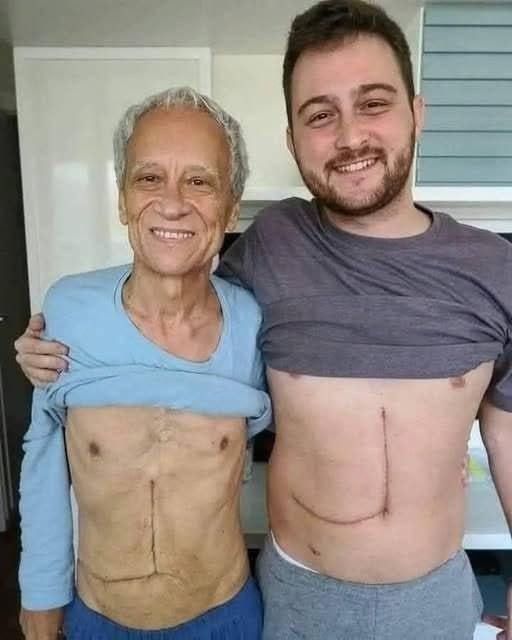
In many clinical scenarios, the mantle of the donor is taken up by an adult child. Consider the specific, poignant narrative of a son discovering his father’s liver function is in terminal decline. Without hesitation, the son steps forward, volunteering for the rigorous gauntlet of testing required to determine compatibility.
The preparation is exhaustive. Medical teams conduct deep-dive evaluations to ensure the potential donor is in peak physical health and possesses a complete psychological understanding of the journey ahead. When the “green light” is finally given, the atmosphere within the family often shifts from one of quiet desperation to one of cautious optimism.
The surgery itself is a choreographed masterpiece of modern medicine. Performed at specialized transplant centers, the donor and recipient are operated on simultaneously in adjacent theaters. This dual-track approach is designed to minimize “ischemic time”—the period the liver segment spends outside the body—ensuring the highest possible chance of successful integration.
“The son’s decision becomes more than a medical solution; it is a source of inspiration, proving that even in our most vulnerable moments, the strength of family love can provide a path forward.”
Navigating the Hard Truths of Recovery
While the majority of living donations result in triumphant outcomes, a seasoned journalist knows that transparency is essential. Recovery is rarely a linear path. It is a major abdominal procedure that demands significant time for the body to recalibrate.
Donors typically face an initial hospital stay of several days for intensive monitoring, followed by a recovery period that spans weeks or even months before a return to “normal” life is possible. Experts emphasize that hurdles, though managed by elite medical teams, are a reality of the process:
-
Common Complications: Donors may face temporary infections, fluid accumulation, or fluctuations in liver function.
-
Serious Risks: While rarer, significant complications can occur, requiring extended medical intervention and specialized care.
-
The Emotional Weight: For families, especially those in their later years, these risks require honest, sobering conversations with surgeons to weigh the immense benefits against the physical toll.
Yet, despite these potential obstacles, the narrative remains overwhelmingly positive. A vast majority of donors report that they would make the exact same choice again, citing the “extra years” gained with their loved ones as an incomparable reward.
The Ripple Effect: How Trials Forge Stronger Ties
The impact of a transplant extends far beyond the two people on the operating tables. It acts as a catalyst for family unity. We see siblings, spouses, and grandchildren rallying together—organizing meal trains, managing household errands, and providing the emotional scaffolding necessary for a long recovery.
Communities often mirror this support. In the digital age, waves of encouragement flow through online channels, while local groups provide tangible assistance. These collective acts of kindness reinforce the idea that no family walks this path alone.
Legacy and Reflection: A Future Defined by Hope
At its heart, living liver donation is about reclaiming time. It is about a father gaining the energy to walk his daughter down the aisle, or a grandfather having the strength to share stories with a new generation.
As we age, these accounts prompt us to have necessary, albeit difficult, conversations about health and our own family legacies. They remind us to cherish the connections we have and to appreciate the miraculous medical options that characterize our modern era.
While every medical journey carries a degree of uncertainty, the courage inherent in living donation leaves an indelible mark. It is a story of human resilience, proving that love—when backed by science—has the power to literally regenerate a future.